

Sam Sifton
Food writer
Sam Sifton is the founding editor of NYT Cooking, and an assistant managing editor leading culture and lifestyle coverage for The New York Times. He’s also a cookbook author and one of the writers of the Cooking newsletter.
Books & Sources
Recipes

7Up Cake
Sam Sifton · NYT Cooking
I love a clandestine soda in the preparation of food, a flash of carbonation where the French might use wine, or brandy. It may be transgressive to say so, but I’m hardly alone, for all those who cringe at the thought. Page through church or community cookbooks and you’ll find examples: Coke-spiked Jell-O situations, root beer-glazed fillets of salmon, beans simmered in Moxie. This recipe for a lemon-and-lime soda cake came to me a while back from a Times reader who thought I’d appreciate it (I did!). She said she’d gotten it from a grandmother down south, who stored it on an index card placed in her copy of the cookbook published by the Symphony League of Jackson, Miss., in 1971. The original called for oleo and Crisco oil. I swapped these out for dairy and neutral oil, and a little less soda, and an additional 15 minutes in the oven. This leaves the cake toast-brown and glistening, glossy-crumbed and high-risen, a marvelous moist yellow within. I’m no shill for Big Soda. You could ju

Almond and Dried Fruit Pilaf With Rotisserie Chicken
Sam Sifton · NYT Cooking
This is a no-recipe recipe, a recipe without an ingredients list or steps. It invites you to improvise in the kitchen. Here's a free-form rice pilaf, made with onions, dried fruit and slivered almonds. First, melt a knob of butter in a pot, then sauté a sliced onion in it until translucent. Add rice, as much as you want to cook, and stir it around, then add water in its usual ratio to the rice, and cook as you always do. At the end, add some chopped prunes, or currants, or raisins, or all three, along with a handful of slivered almonds and salt and pepper. Fluff the rice to mix everything together. Put the top back on the pot, and let the rice and mix-ins mellow out for a few minutes. Serve alongside a store-bought roast chicken, the legs and thighs separated and the breasts cut on the bias and fanned out for show. Sam Sifton features a no-recipe recipe every Wednesday in his What to Cook newsletter. Sign up to receive it. You can find more no-recipe recipes here.

Beef Stroganoff
Sam Sifton · NYT Cooking
Forget what you think you remember about this putatively Russian dish, which saw its zenith in American kitchens during the 1950s and its nadir in school cafeterias two decades later. Beef stroganoff makes for an outstanding dinner: a vat of tender sautéed meat in a silken gravy studded with caramelized mushrooms, alongside a huge tangle of buttered noodles. Be careful when adding the cream at the end: Sour cream easily curdles in the heat, while crème fraîche or heavy cream offer smoother results.

Bobby Flay’s Double-Chocolate Pancakes
Sam Sifton · NYT Cooking
Few adults would want this meal for breakfast, but it is an excellent recipe for parents to make the morning after a sleepover that had the children and their friends up late watching horror films and unfathomable YouTube comedy. I adapted it slightly from Bobby Flay’s “Brunch at Bobby’s” cookbook, released in 2015. Watching the effect of the sugar and chocolate on a sleepy child is its own sort of joy – and you can hustle the guests home before the inevitable crash. Serve with raspberries for reasons of taste and elegance (though strawberries or bananas would do in a pinch), and salted caramel sauce. Yes, you could insist on eating muesli and almond milk instead. But in Mr. Flay’s words, “If you’re going to cave, you might as well go all out.” Sam Sifton

Bobby Flay’s Salted Caramel Sauce
Sam Sifton · NYT Cooking
Make a batch of this sauce before guests come to dinner, keep it warm in the oven while they eat, then spoon it over vanilla ice cream for dessert: That’s a win. Or make it in the morning and pair it with pancakes. Mr. Flay, the voluble chef and television star, pairs it with double-chocolate pancakes. That is a very serious business. Sam Sifton

Bulgogi Sliders With Scallion Salsa
Sam Sifton · NYT Cooking
Here is a sandwich version of the Korean barbecue standard known as bulgogi — “fire meat,” is the literal translation — and a taste of the sort of home cooking that can lead to more home cooking. It serves as a fragrant hamburger crusher, an elegant vanquisher of pizza. It is an enemy of takeout. I learned the recipe from Hooni Kim, the chef and owner of Danji, on the edge of the theater district in Manhattan, where bulgogi “sliders” are a hallmark of the menu and by far the restaurant’s most popular dish. It’s been adapted for use in the home. Sam Sifton

Bulgogi-Style Tofu
Sam Sifton · NYT Cooking
This is a no-recipe recipe, a recipe without an ingredient list or steps. It invites you to improvise in the kitchen. Here's the prompt: bulgogi-style tofu. It’s simple. Press some firm tofu to extract as much liquid as you can. Make a marinade of soy sauce, brown sugar, sesame oil, minced garlic, grated ginger, a spoonful of gochujang, a splash of neutral oil, some sliced scallions and toasted sesame seeds. Slice the tofu into bite-size cubes, and slide them into the marinade. Let that sit — a half-hour works; a few hours works better. Then roast them in a hot oven on an oiled foil-lined pan until they’re crisp. Serve with bibb lettuce cups to wrap them in, with rice, kimchi and a dipping sauce of ssamjang and a little bit more gochujang thinned out with neutral oil and sherry vinegar. (If not, go with sesame oil and ground white pepper.) That’s a fine dinner. For more recipe recommendations from Sam Sifton, Melissa Clark and New York Times Cooking, sign up to receive the Cooking news

Canlis Salad
Sam Sifton · NYT Cooking
Canlis, a longtime Seattle institution, floats high above Lake Union. A menu highlight is the Canlis salad, which is in some measure a basic steakhouse salad: chopped romaine with bacon and croutons and cherry tomatoes, all cloaked in a thick, lemony dressing that recalls Caesar (you all did love him once, and not without cause). But a strong scent of the Middle East flows through it as well, courtesy of the Canlis clan’s roots in Greece and Lebanon, with heaps of chopped mint and oregano mixed in with the greens. These combine with the bright, eggy taste of the dressing to elevate the entirety far beyond the confines of a salad to be eaten simply with meat and potatoes. A Canlis salad, properly prepared, is a revelation. Sam Sifton
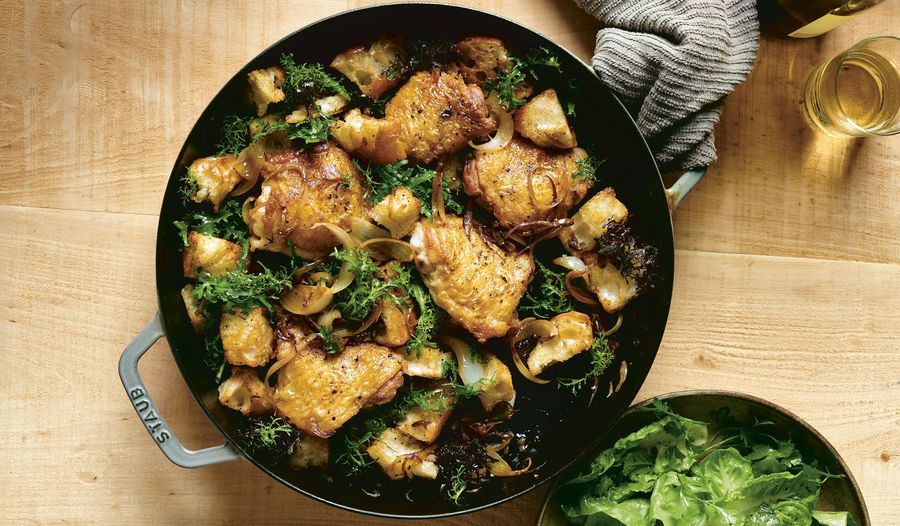
Chicken with Caramelised Onions and Croutons
Sam Sifton · The New York Times Cooking: No-Recipe Recipes
You need just a handful of basic ingredients to create this deeply flavoursome midweek meal of chicken with caramelised onions and croutons.

Chinese Roast Pork on Garlic Bread
Sam Sifton · NYT Cooking
Chinese roast pork on garlic bread is one of the great New York sandwiches, a taste of the highest peaks of Catskills cuisine: thinly sliced, Cantonese-style char siu married to Italian-American garlic bread beneath a veil of sweet-sticky duck sauce. It’s been around since the 1950s, a favorite of the summertime borscht belt crowd. You can make the sandwich with store-bought char siu if you like, but I prefer the homemade variety because I can make it with fancy pork from the farmers’ market. It’s also juicier and more flavorful. Then, layer the meat onto garlic bread, and add a drizzle of duck sauce – for that, I use leftover packets from Chinese takeout orders or make my own with apricot preserves cut through with vinegar. Some people add a slash of hot mustard; others fresh pickles, or coleslaw. “It’s the ultimate assimilation crossover food,” the food writer and erstwhile restaurant critic Arthur Schwartz told me. “That sandwich is a symbol of acculturation.”
Chris Schlesinger’s Pulled Pork
Sam Sifton · NYT Cooking
Mr. Schlesinger is the chef and an owner of the East Coast Grill in Cambridge, Mass., which he opened in 1985. He is also the author, with John Willoughby, of six cookbooks that relate somehow to the pleasures of fire. This is an adaptation of his recipe that calls for slowly cooking the pork over coals for almost 14 hours, but that's largely unattended, and your patience will be rewarded. Sam Sifton

Craig Claiborne’s Smothered Chicken
Sam Sifton · NYT Cooking
Craig Claiborne was a child of Mississippi who started as food editor of The Times in 1957 and did as much as anyone to help bring home cooking into the spotlight. The dish “belongs in the ‘comfort’ category,” he wrote in 1983, “a food that gives solace to the spirit when you dine on it.” You could give your smothered chicken some European flair with mushrooms and small onions in the gravy, as Claiborne did in his experiments with Pierre Franey, then his kitchen co-pilot. Or you could send yourself south to the Creole tastes of the Delta, with a blend of tomatoes, chopped celery, onion and green peppers added to the sauce. But sometimes the easiest way is the best. Try it. Sam Sifton

Curried Rice
Sam Sifton · NYT Cooking
I ate a version of this rice as an accompaniment to a few deep-fried paddles of Australian crab, sitting at the kitchen counter of Paul Carmichael’s excellent Momofuku Seiobo in Sydney. It tasted of a world far away, of Mr. Carmichael’s childhood in Barbados, in the Lesser Antilles, where influences of Africa, India, China and Britain combine in the food: the grains fried in butter scented with murky yellow curry powder, warm and fragrant, and flavored with fiery minced habanero and a salty punch of soy and oyster sauces. I sighed when I finished and asked for a recipe. I’ve been messing with it ever since. Please note: You’ll end up with more curry paste than you’ll need to season the rice, even if you season aggressively. Refrigerate the extra to make the dish a second time (it keeps well), or to enliven ground meat for a Caribbean-ish version of sloppy joes, even just to improve a bowl of instant ramen. Sam Sifton

Daniel Boulud’s Chicken Tagine
Sam Sifton · NYT Cooking
This recipe for an elegant North African stew comes out of the kitchen of Boulud Sud, Daniel Boulud’s sophisticated Mediterranean French restaurant in New York. It is a dish steeped in the flavors of North Africa, but also of France. Chicken serves as the protein, bathed in a blend of North African spices — cinnamon and coriander, turmeric, ginger powder and cardamom — combined with tomatoes, saffron and a little stock. Preserved lemons and olives added at the end provide bite. Tagines are often cooked with root vegetables and dried fruits. Boulud, who famously grew up on a farm, in Lyon, uses cauliflower. ‘‘It is maybe a little more French approach to the tagine,’’ he said. Blanching the cauliflower and tomatoes before cooking them may cause some cooks to blanch themselves. But the effort is worth it. Sam Sifton

Eastern North Carolina-Style BBQ Sauce
Sam Sifton · NYT Cooking
Chris Schlesinger is the chef and an owner of the East Coast Grill in Cambridge, Mass., which he opened in 1985. He is also the author, with John Willoughby, of six cookbooks that relate somehow to the pleasures of fire. This is an adaptation of his recipe for barbecue sauce meant to be served with his pulled pork. Sam Sifton

Florida Lime Pie
Sam Sifton · NYT Cooking
Jane Nickerson was the food editor of The New York Times from 1942 until 1957, when she moved with her family to Lakeland, Fla. There, she eventually became food editor of The Ledger, in Lakeland, then owned by The Times. Her successor in New York was Craig Claiborne, whose star eclipsed hers for, among other things, systemic reasons we wrestle with still. But Ms. Nickerson was a hugely influential force in American home cooking, introducing ingredients and recipes from chefs and home cooks to a nation that met her first on a wartime footing and grew to find itself on a prosperous one. In Florida, she embraced local ingredients and foodways, and in 1973 published “Jane Nickerson’s Florida Cookbook,” an invaluable guide to the state’s appetizing abundance. Her lime pie is a little richer than the more well-known Key lime pie. I like that about it. Sam Sifton

Fluke au Gratin
Sam Sifton · NYT Cooking
This is a very old recipe, taken from the kitchen of Henri’s in Lynbrook, N.Y., opened by an extravagant French restaurateur named Henri Charpentier in 1910. It asks for flounder, known on Long Island as fluke, but you could make it with cod or haddock or halibut, with freshwater trout or catfish, with any mild-flavored fish. It’s an elegant and really quite simple preparation, the fish fillets baked on top of and beneath a butter sauce cooked with chopped shallots, garlic, chives, parsley and minced mushrooms, brightened with lemon juice and white wine, and with bread crumbs, sliced mushrooms and dots of butter strewn across the top. You can make the sauce in the morning, if you like, and assemble the dish for the oven just before dinner, making it a breeze for weeknight entertaining. But it’s no stretch to do it all, as Charpentier might have said, “à la minute.” Sam Sifton

Fried Rice
Sam Sifton · NYT Cooking
This is a no-recipe recipe, a recipe without an ingredients list or steps. It invites you to improvise in the kitchen. Start with some cooked rice, white or brown, a cup or so per person, made fresh or pulled from the freezer where you keep some in a plastic bag against the promise of just such an exercise. (The chill helps separate the grains.) Also helpful, also in the freezer: bags of diced organic vegetables you can get at the market (the mixed corn, carrots and peas number, for instance). For the rest: meat if you eat meat, a couple eggs, lots of chopped garlic and ginger, some scallions. You can make a sauce from soy sauce and sesame oil (about a 3:1 ratio) and fire it up with a teaspoon or two of gochujang. You’ll need a little less than a quarter cup of sauce to feed four. To the wok! Crank the heat, add a little neutral oil, then toss in your meat. I like chopped brisket from the barbecue joint, or pastrami from the deli, or ground pork, or bacon, or leftover roast chicken — w
Giant Chipotle-Rubbed Steaks With Cilantro-Lime Butter
Sam Sifton · NYT Cooking
This recipe and delicious rub comes from Chris Schlesinger, the former owner and chef of East Coast Grill in Cambridge, Mass. Follow Mr. Schlesinger’s lead and leave the steaks untouched on the grill before you flip them. They should be beautifully seared, chestnut brown around the edges where the fat has roasted down, with a tight crust from the rub. Later, perhaps, you can reward yourself with a beer. Sam Sifton
Grilled Bluefish With Chourico And Clams
Sam Sifton · NYT Cooking
Sam Sifton

Grilled Broccoli With Soy Sauce, Maple Syrup and Balsamic Vinegar
Sam Sifton · NYT Cooking
This is a no-recipe recipe, a recipe without an ingredients list or steps. It invites you to improvise in the kitchen. This is good one to have in your back pocket when you’re cooking burgers and dogs on the grill; it’s a no-recipe version of a dish that I first learned of from the Brooklyn restaurateur Joe Carroll. Toss broccoli florets in equal parts soy sauce and balsamic vinegar, a generous dash of maple syrup and a splash of neutral oil, then grill (or broil) until they’re soft and crunchy. Serve them under a scattering of red-pepper flakes and sesame seeds, or use furikake, a Japanese seasoning blend that contains, in addition to sesame, chopped seaweed, sugar, salt and, occasionally, monosodium glutamate. Never mind hot dogs or anything else, actually. I could go for that broccoli on white rice and call it dinner, full stop. Sam Sifton features a no-recipe recipe every Wednesday in his What to Cook newsletter. Sign up to receive it. You can find more no-recipe recipes here.

Grilled Cheese With Jalapeño, Tomato and Fried Egg
Sam Sifton · NYT Cooking
This is a no-recipe recipe, a recipe without an ingredients list or steps. It invites you to improvise in the kitchen. Sometimes I get it into my head to make a fancy grilled cheese sandwich. I don’t have a recipe because you don’t really need a recipe to make grilled cheese sandwiches. You just need desire, and a triangle in your head: salt; crunch; melting ooze. So I’ll slice some mild Cheddar. Get some decent bread, a sliced jalapeño, the tail end of a beefsteak tomato. Then, sizzle-sizzle-flip-flip in some unsalted butter, and top with a sunny-side-up egg. It’s the simplest kind of cooking, and on a weeknight that’s exactly what most of us need. Make grilled cheese! Sam Sifton features a no-recipe recipe every Wednesday in his What to Cook newsletter. Sign up to receive it. You can find more no-recipe recipes here.

Grilled Hamburgers
Sam Sifton · NYT Cooking
We cook a lot of burgers indoors on a fat-slicked iron skillet, and you can do that on a grill as well. (Here’s our burger guide for more information and inspiration.) But sometimes you want a smoky grilled burger. For that, a charcoal grill is best, but a gas grill can do the trick, too. Resist the temptation to press down on the burgers with a spatula, which only spews juice and fat on the fire, causing the flames to flare up and the burger to lose flavor. If you feel your burger is cooking too quickly, use the cooler sides of the grill to rest them. And remember: lowering the top on the grill helps cheese melt.
Grilled Pork Chops With Glazed Peaches
Sam Sifton · NYT Cooking
Sam Sifton

Guinness Pie
Sam Sifton · NYT Cooking
Beef in dark, silky gravy composed of fat and reduced stout, flecked with tender vegetables, covered in pastry: This is a dish that delivers good cheer and contentment in equal measure. We built it out of advice and instruction from the British chefs Jamie Oliver (the stew) and Fergus Henderson (the pastry). Eating it — salty and rich, buttoned with sweetness — will occasion thoughts of a coming walk or a nap on the couch with the dog. You’ll want some red wine to drink. It's awesome. Sam Sifton

Ham and Cheese Pasta With a Handful of Peas
Sam Sifton · NYT Cooking
This is a no-recipe recipe, a recipe without an ingredients list or steps. It invites you to improvise in the kitchen. Pick up a box of large shells — the ones the size of a knuckle, so they hold a little pasta water in them. Pick up a ham steak from the butcher or the corner of the supermarket meat display, and dice it. Pick up a bag of frozen organic peas as well — they’re sweeter. You’ll need a block of good Swiss if you can find it, or some Jarlsberg if you can’t. (Hey, it melts like a dream.) Set a large pot of salted water to boil, and prepare your pasta. While it cooks, get to work on the next burner, browning the ham in a pat of good unsalted butter in a skillet. Offstage, grate about a cup of cheese into a large serving bowl. When the pasta has been cooked for just shy of the time called for on its packaging, throw in a handful of peas, cook another minute, then drain, reserving a little cooking water. Toss the whole mess into the cheese, along with the hot ham, another pat or

Hasselback Kielbasa
Sam Sifton · NYT Cooking
This is a no-recipe recipe, a recipe without an ingredients list or steps. It invites you to improvise in the kitchen. Get a sheet pan ripping hot in a 425-degree oven while you cut up a small onion and a bell pepper, whatever color you prefer. Toss the vegetables in a splash of neutral oil, salt and pepper them, and tip them into a single layer on the hot pan. Allow these to roast in the oven while you cut the kielbasa into thin slices, stopping short of cutting all the way through the meat. You want to end up with a long accordion, basically, or an attenuated pill bug. Now remove the vegetables from the oven, give them a stir, and put the kielbasa on top. Return the sheet pan to the oven and allow everything to roast into crisp softness, 20 to 25 minutes, basting heavily two or three times with a mixture of equal parts apricot preserves and mustard, about 2 tablespoons each. Serve with steamed greens or a fresh baguette. It’ll go fast. Sam Sifton features a no-recipe recipe every Wed

Ina Garten’s Make-Ahead Coquilles St.-Jacques
Sam Sifton · NYT Cooking
Here is an easy version of coquilles St.-Jacques, the classic French preparation of scallops in a creamy sauce, under a crust of bread crumbs and cheese. It comes from Ina Garten, the celebrated cookbook author and television star, who has been cooking it for dinner parties, she told The Times, practically since the start of her marriage to Jeffrey Garten in 1968. It makes for a beautiful entree that matches well with a green salad, flinty white wine and good conversation. It can be made the day before serving and heated through in an oven while guests gather. “A lot of dishes taste better after they sit for a while,” Garten said. With its whisper of curry powder in the rich, unctuous sauce, this is one of them. You can make it in a casserole, but little gratin dishes are better and come in handy far more often than you might think. One per guest. Sam Sifton

Jamie Oliver’s Chicken in Milk
Sam Sifton · NYT Cooking
The British chef and cooking star Jamie Oliver once called this recipe, which is based on a classic Italian one for pork in milk, “a slightly odd but really fantastic combination that must be tried.” Years later he told me that that characterization made him laugh. “I was hardly upselling its virtues,” he said. The dish’s merits are, in fact, legion. You sear a whole chicken in butter and a little oil, then dump out most of the fat and add cinnamon and garlic to the pot, along with a ton of lemon peel, sage leaves and a few cups of milk, then slide it into a hot oven to create one of the great dinners of all time. The milk breaks apart in the acidity and heat to become a ropy and fascinating sauce, and the garlic goes soft and sweet within it, its fragrance filigreed with the cinnamon and sage. The lemon meanwhile brightens all around it, and there is even a little bit of crispness to the skin, a textural miracle. It is the sort of meal you might cook once a month for a good long while

Japanese-Style Tuna Noodle Salad
Sam Sifton · NYT Cooking
Here’s a simple udon salad I picked up from the chef and entrepreneur Bart van Olphen, who elevates canned tuna to the heights of deliciousness. Van Olphen dresses the noodles in what he calls wafu dressing, which translates roughly as Japanese-style: a sweet-salty vinaigrette of soy, sesame oil, mirin and rice vinegar. I add a little sweet miso for texture and taste, and increase the amount of seaweed in the salad as well. Garnish with sesame seeds or furikake, the Japanese seasoning blend, and you have a superior tuna casserole. It is as good served cold as hot. Sam Sifton

Jerusalem Grill
Sam Sifton · NYT Cooking
This recipe for griddled chicken thighs with chicken livers and hearts comes from Mike Solomonov and Steven Cook, the Philadelphia restaurateurs whose cookbook, “Israeli Soul,” is an invaluable guide to making Israel’s most beloved street foods and restaurant dishes at home. But you don't need to make it with the livers and hearts. “I like a little funk in there,” Solomonov told me, “but I get it if you don’t like that, if it freaks you out.” So omit the offal if you want. “The dish is as much about the spicing, anyway,” Solomonov said. Serve the meat mounded onto a drift of hummus, as you might spoon a thick ragù on top of polenta, or alone beside a salad. Solomonov likes it as a sandwich. “Eat mixed grill in a pita,” he said. “Eat it with some onion and tehina and a pickle, and it’s so satisfying. It’s a taste of Jerusalem at the end of the night.” Sam Sifton

Kale Salad With Cranberries, Pecans and Blue Cheese
Sam Sifton · NYT Cooking
This is a no-recipe recipe, a recipe without an ingredients list or steps. It invites you to improvise in the kitchen. How about a kale salad? (Stick with me, please.) Just make a mustardy vinaigrette that’ll stand up to the greens — mustard, olive oil, a splash of lemon juice, salt and pepper — then drizzle it over clean, chopped kale with a host of big-flavored mix-ins that wink at whatever season you’re in without being dorky about it: dried cranberries or currants, say; pecans toasted with maple syrup and a pinch of cayenne; some crumbled blue cheese; a spray of croutons. Sweet, salty, spicy, sour. That and a chilled glass of red wine? Why don’t we eat salads for dinner more often? Sam Sifton features a no-recipe recipe every Wednesday in his What to Cook newsletter. Sign up to receive it. You can find more no-recipe recipes here.

Kombucha
Sam Sifton · NYT Cooking
To make this effervescent fermented tea, you will need a symbiotic culture of bacteria and yeast that is known by its acronym, Scoby. Also some already-brewed kombucha that you will most likely receive from the same source as the Scoby — a friend or the Internet. You'll need very clean glass jars in which to brew your sweetened tea and ferment it with your Scoby, and very clean clamp-top bottles into which to funnel it when you’re done. You’ll need flavoring agents for that second fermentation. Start with apple juice, perhaps, and ginger. With later batches you can try turmeric, pomegranate, cayenne, orange, whatever you like. Welcome to the kombucha lifestyle.

Lamb Meatballs With Spiced Tomato Sauce
Sam Sifton · NYT Cooking
Here is a recipe from the Los Angeles chef Suzanne Goin that plays to children as well as to the most sophisticated of palates. It is for crisp lamb meatballs cooked through in a fragrant North African-inspired sauce of tomato sauce zipped up with orange juice and warm spices, then topped with feta and mint. Ms. Goin first served the dish at one of her Los Angeles restaurants, and put it into ‘‘The A.O.C. Cookbook’’ (Knopf, 2013), devoted to that restaurant’s food. A version of the dish was later introduced to the menu of her children’s school. It can be cooked in an hour’s time, not all of it busy, and served with pita or plain pasta, bulgur or couscous. Sam Sifton

Lemon Poundcake
Sam Sifton · NYT Cooking
This recipe came to The Times in 2001 in an article by the chef Bill Yosses, who would go on to become the executive pastry chef for the Obama White House. He learned it, he wrote, in France, from a pastry chef named Jacques Mahou at Au Vieux Four in Tours. "He had a special technique," Yosses wrote. "Instead of brushing the cake with a sweet syrup, Jacques immersed his in a lemon syrup bath. Then he gently squeezed the cake like a sponge. It was a tricky maneuver since the warm loaf was apt to fall apart -- you have to cradle it gently, and apply just a little bit of pressure -- but it's worth the extra care. The cake absorbs a lot more liquid, which moistens the interior and intensifies the citrus flavor." In addition, Yosses added lemon segments to the batter. "The fruit evaporates, leaving behind powerful little pockets of lemon," he wrote. "It makes a major difference. The lemon segments, combined with the syrup, also help preserve the cake. Well wrapped and stored in the refriger

Maangchi’s Cheese Buldak (Fire Chicken)
Sam Sifton · NYT Cooking
Cheese buldak is a Korean dish that is incredibly easy to prepare: a marinade of red-pepper paste and red-pepper flakes that becomes a fiery sauce for braised chicken, which is then served beneath a cloak of broiler-melted mozzarella. A child could do it, or an adult who often acts like one. Mine is an adaptation of a recipe that owes its deepest debt to Emily Kim, the Korean web star known as Maangchi, whose video for cheese buldak has been viewed on YouTube more than seven million times. (Omit the rice cakes if you can’t find them easily!) Thanks to subtitling by her fans, the video can be read in 24 languages. There are thousands and thousands of comments below it, mostly positive. One reads, “Can you be my mom?” Sam Sifton

Mapo Ragù
Sam Sifton · NYT Cooking
This is my simple, everyday take on a dish developed at Momofuku Ssam Bar in Manhattan many years ago by the chefs David Chang and Tien Ho and their band of collaborators. It is almost literally a mashup: a meal that is kind of Korean, kind of Chinese, kind of Italian. If you don’t like spicy food, use miso instead of the gochujang and don’t use Sichuan peppercorns, which add a numbing, tingly pop to the fire. (If you like really spicy food, add dried chiles or hot pepper flakes to the recipe at the point you add the gochujang.) And if you want to make it even more luxe than it is already, follow the lead of Chang’s crew and stir 6 ounces of silken tofu into the sauce at the end. Sam Sifton

Miso-Glazed Eggplant With a Bowl of Rice
Sam Sifton · NYT Cooking
This is a no-recipe recipe, a recipe without an ingredients list or steps. It invites you to improvise in the kitchen. You know how to make rice. For the rest of this dish, grab some small eggplants — the Japanese variety is a good option — and cut them on the bias into little steaks. Drizzle them with neutral oil and roast in a 400-degree oven for 20 minutes or so, turning them once or twice, until they’re soft. Then crank the oven to broil, and paint them with white miso that’s been cut with splashes of sesame oil and rice wine, a smaller splash of soy and a few grinds of black pepper. Let that get going until the skin begins to pop, then serve those little vegetarian flavor steaks over rice, with a spray of sesame seeds over the top. Sam Sifton features a no-recipe recipe every Wednesday in his What to Cook newsletter. Sign up to receive it. You can find more no-recipe recipes here.

Momofuku’s Bo Ssam
Sam Sifton · NYT Cooking
This is a recipe to win the dinner party sweepstakes, and at very low stakes: slow-roasted pork shoulder served with lettuce, rice and a raft of condiments. The chef David Chang serves the dish, known by its Korean name, bo ssam, at his Momofuku restaurant in the East Village and elsewhere. He shared the recipe with The Times in 2012. Mr. Chang is known as a kitchen innovator, but his bo ssam is a remarkably straightforward way to achieve high-level excellence with little more than ingredients and time. Simply cure the pork overnight beneath a shower of salt and some sugar, then roast it in a low oven until it collapses. Apply some brown sugar and a little more salt, then roast the skin a while longer until it takes on the quality of glistening bark. Meanwhile, make condiments – hot sauces and kimchi, rice, some oysters if you wish. Then tear meat off the bone and wrap it in lettuce, and keep at that until everything’s gone. Sam Sifton
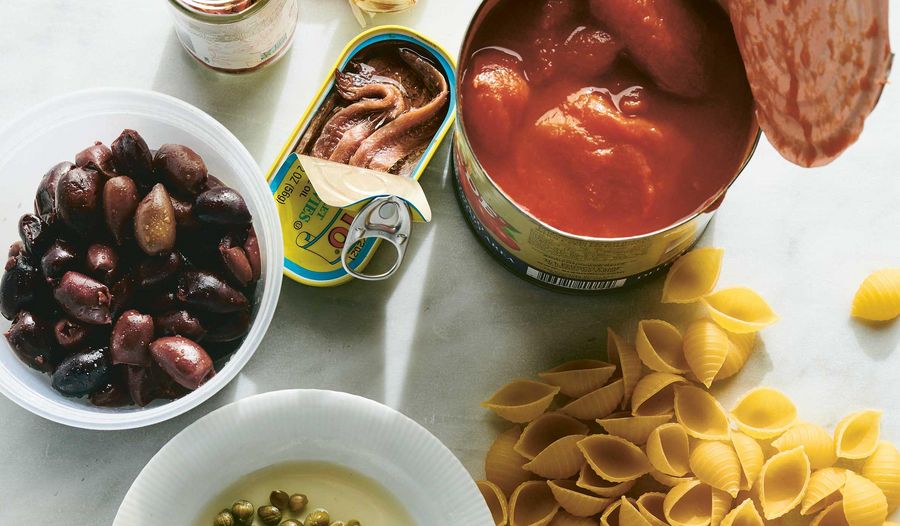
Pasta Puttanesca
Sam Sifton · The New York Times Cooking: No-Recipe Recipes
This "no-recipe" recipe for pasta puttanesca from NYT Cooking editor, Sam Sifton, is the perfect dish to rustle up with the contents of your store cupboard.
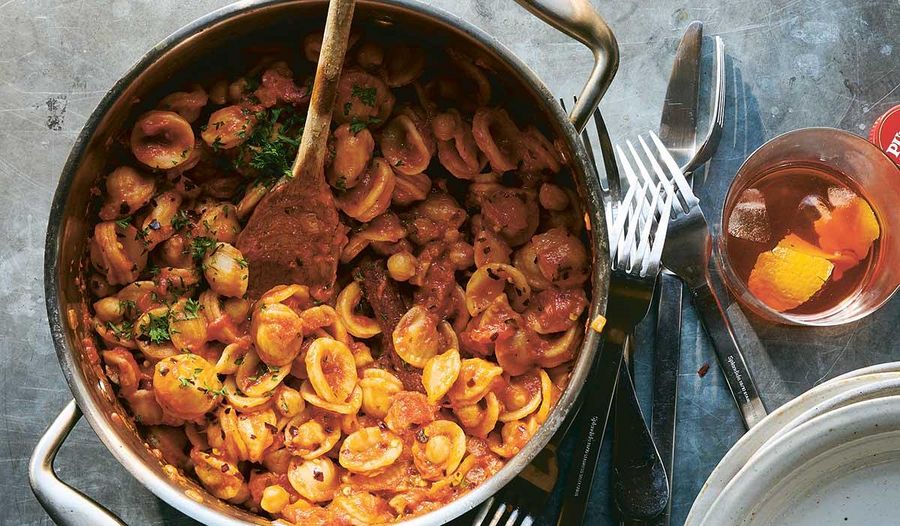
Pasta with Chickpeas and a Negroni
Sam Sifton · The New York Times Cooking: No-Recipe Recipes
This refreshingly simple 'no-recipe recipe' from founding editor of NYT Cooking, Sam Sifton, is a store cupboard hero with specific instructions to serve alongside a negroni.

Peanut Butter Sandwich With Sriracha and Pickles
Sam Sifton · NYT Cooking
This is a no-recipe recipe, a recipe without an ingredients list or steps. It invites you to improvise in the kitchen. Here’s a spin on a great old sandwich of the American South: peanut butter and pickle sandwiches with a spray of sriracha or sambal oelek, and a tiny drizzle of soy sauce. Toasting the bread before spreading it with peanut butter adds crunch and warmth, and the result is a sandwich of remarkable intensity, sweet and salty, sour and soft and crisp. Trust me on this one! Sam Sifton features a no-recipe recipe every Wednesday in his What to Cook newsletter. Sign up to receive it. You can find more no-recipe recipes here.

Pizza Margherita
Sam Sifton · NYT Cooking
Here is the archetype of a thin-crust pizza pie, a pizza margherita adorned simply in the colors of the Italian flag: green from basil, white from mozzarella, red from tomato sauce. This pizza is adapted from the recipe used by the staff at Roberta’s restaurant in Brooklyn, who make their tomato sauce simply by whizzing together canned tomatoes, a drizzle of olive oil and a pinch of salt. The ingredients offer in their proportions what appears to be a kind of austerity — not even 3 ounces of cheese! But the result is home-cooked pizza to beat the band, exactly the sort of recipe to start a career in home pizza-making, and to return to again and again. Sam Sifton

Pork Chops in Cherry-Pepper Sauce
Sam Sifton · NYT Cooking
You can use this sauce — spicy and fragrant and slightly syrupy, what the Italians call agrodolce — on pork chops as I call for here, or on veal chops, on steaks, on chicken. I bet it’d be good on grilled seitan or drizzled over tofu. The recipe is reminiscent of the cooking at red-sauce emporia like Bamonte’s in Brooklyn, Rao’s in Manhattan, Dominick’s in the Bronx and, I hope, Carbone in Greenwich Village, where I first learned how to put it together at the elbow of the chef Mario Carbone. Serve with spaghetti dressed in butter and Parmesan, with garlic bread, with a spoon so you can slurp what’s left on the plate. “It’s a flavor that’s purely Italian-American,” Carbone told me. “You won’t find it in Italy, no way.”

Pork Chops in Lemon-Caper Sauce
Sam Sifton · NYT Cooking
Here’s my favorite recipe in Toni Tipton-Martin’s excellent and invaluable “Jubilee: Recipes From Two Centuries of African American Cooking” (2019). It’s a remix of one that the chef Nathaniel Burton collected into his 1978 opus, “Creole Feast: Fifteen Master Chefs of New Orleans Reveal Their Secrets,” and one that Tipton-Martin glossed-up with lemon zest, juice and extra butter, a technique she learned from the restaurateur B. Smith’s 2009 collection of recipes, “B. Smith Cooks Southern-Style.” It’s a dish of smothered pork chops, essentially, made into something glorious and elegant. “The food history of Blacks in America has been a story of the food of survival,” she told me in an interview. “We need to start celebrating the food they made at work." Sam Sifton

Pork Chops With Onion Gravy
Sam Sifton · NYT Cooking
This is a no-recipe recipe, a recipe without an ingredient list or steps. It invites you to improvise in the kitchen. Start with the pork chops, as many as you need, on the bone if possible. Dredge them in flour that you’ve mixed with chile powder, salt, black pepper, smoked paprika and red-pepper flakes, or with Lawry’s seasoned salt or Old Bay seasoning or any spice you like, really. (Save what’s left of the flour; you’ll use it later.) Then sear the chops, in batches if you have to, in an oil-slicked Dutch oven or heavy cast-iron pan, over fairly high heat. You want a big, flavorful crust on the meat before you braise it with the onions, to enhance the taste of the sauce and provide a little texture. Set the seared chops on a platter. Throw away what oil is left in the pot, and wipe out the pot. Return it to the stove, and set over medium heat. Add some butter, and when it melts and foams, use it to sauté an enormous number of sliced onions, allowing them to wilt and soften and almo

Pulled Pork
Sam Sifton · NYT Cooking
The chef and barbecue madman Chris Schlesinger sold the East Coast Grill, his restaurant in Cambridge, Mass., in 2012. But his recipe for pulled pork, which adorned the restaurant’s menu from its opening in 1985, lives on in this excellent version he gave to The Times in 2003: a tangle of soft, vinegar-scented pork that pairs extremely well with coleslaw on top of a cheap hamburger bun. Cooking the dish can be an all-day or an all-night affair, the meat luxuriating in a bath of hardwood smoke, but it is hardly taxing for anyone with a kettle grill and 12 hours on hand. “Barbecue is such a typical guy thing to do,” Schlesinger said at the time. “Much ado about nothing.” But the results put the lie to the time spent spacing out, watching the smoke curl up into the sky. Schlesinger agreed. “It is intense,” he said. Sam Sifton

Quick-Broiled Pork Chops With Peanuts and Gochujang
Sam Sifton · NYT Cooking
This is a no-recipe recipe, a recipe without an ingredients list or steps. It invites you to improvise in the kitchen. Here’s a nice Wednesday-night meal. Secure the thinnest chops you can find at the store — that’s crucial for the quick-broil part. Throw a few handfuls of dry-roasted peanuts in a pan set over medium-high heat with a glug of sesame oil. Let those go until they’re fragrant and just beginning to darken, then take them off the heat and toss with a few shakes of chile powder. Set the peanuts aside and heat your broiler. Line a sheet pan with foil, and oil it lightly. Salt and pepper your chops, lay them out on the pan, and slide them into the oven. Cook the chops for around four minutes, then flip them over to finish. Meanwhile, mix a tablespoon or so of gochujang, the Korean red-pepper paste, with a healthy splash of orange juice and a wisp of mirin. Taste. Adjust. Pour into a deep serving dish or platter. When the chops are well crusted and brown, slide them into the sau

Red-Cooked Beef Short Ribs
Sam Sifton · NYT Cooking
Traditional red-cooked dishes — they take their name from the mahogany color the sauce imparts to the meat — are simple braises of rice wine, light and dark soy sauces, with some sugar and aromatics. The version Jennifer Hwa Dobbertin and Quealy Watson serve at Best Quality Daughter, their restaurant in San Antonio, turbocharges that formula. Dried chiles and Sichuan peppercorns bring fire and tingle, and star anise and cinnamon provide warmth. There’s a whisper of orange, a bite of ginger. Tomato paste and doubanjiang, a fermented chile bean paste, offer depth. Do take the time to use some of the braising liquid to serve as the base for the finishing glaze, thick and glossy as demi-glace. It’s worth it. Sam Sifton

Rice and Beans With Extras
Sam Sifton · NYT Cooking
This is a no-recipe recipe, a recipe without an ingredients list or steps. It invites you to improvise in the kitchen. Maybe tonight is calling for simple rice and beans, with limes to squeeze over the plate, warm tortillas to scoop up the food? First, rinse a cup or two of rice and cook as you usually do. As it steams away, dice an onion and sweat it in a saucepan with a drizzle or two of olive oil set over medium-high heat. When the onion begins to go translucent, add a few cloves of garlic and, if you’d like, some crumbled sausage, ground beef or lamb, then cook until it has started to crisp and the onion has started to caramelize. Add a healthy dusting of cumin, some salt and pepper to taste, and allow it all to go muddy and fragrant. Splash the mixture with the orange juice, maybe half a cup, and allow it to cook down, almost to syrup. Then add a big can of black beans (drained, please) and stir to combine, turning down the heat and allowing the flavors to come together, perhaps u

Roasted Brussels Sprouts
Sam Sifton · NYT Cooking
Here’s a simple, foolproof way to prepare brussels sprouts: Toss with a little olive oil or bacon fat, salt and pepper and roast until tender inside and crisp outside. Finish with a little red-pepper flakes or a drizzle of balsamic vinegar, if you'd like. This recipe serves two, but it doubles or triples easily.

Roasted Fish With Ginger, Scallions and Soy
Sam Sifton · NYT Cooking
This is a no-recipe recipe, a recipe without an ingredients list or steps. It invites you to improvise in the kitchen. Buy a few fillets of the white-fleshed fish you like best (I like fluke, myself), then put a sheet pan in a 425-degree oven and let it get hot. Make a sauce in a small bowl: a few tablespoons of soy sauce for each one of rice wine or sherry, and a heap of minced or grated ginger, and plenty of thinly sliced scallions. You could put some garlic in there, if you like, and a dash of hot chile oil or sesame oil. Salt and pepper the fish, then pull the hot sheet pan out of the oven and get some neutral oil on it. Add the fish to the hot pan carefully, put it in the oven and roast for a minute or so, then paint the sauce onto the fillets and cook for a minute or so longer, until the fish has just cooked through. Serve with rice and greens. And I bet it’d make a good sandwich? Sam Sifton features a no-recipe recipe every Wednesday in his What to Cook newsletter. Sign up to re

Rotisserie Chicken Salad With Greens and Herbs
Sam Sifton · NYT Cooking
This is a no-recipe recipe, a recipe without an ingredients list or steps. It invites you to improvise in the kitchen. Pick up a heat-lamp roast chicken at the market on the way home — it’s O.K.! — and tear it apart to feed four, or half of it for two, shredding the meat with your fingers. Mix the chicken with a few handfuls of baby arugula, a large handful of sliced scallions and a lot of chopped cilantro. Cut an avocado or two into the mix if you have them on hand. Then make a dressing out of lime juice — one juicy squeezed lime will do — a pressed garlic clove and a few glugs of olive oil, seasoned with salt and pepper. Drizzle that over the top and serve. Dinner in 15 minutes, tops. Sam Sifton features a no-recipe recipe every Wednesday in his What to Cook newsletter. Sign up to receive it. You can find more no-recipe recipes here.

Salmon With BBQ Sauce and Hot Peppers
Sam Sifton · NYT Cooking
This is a no-recipe recipe, a recipe without an ingredients list or steps. It invites you to improvise in the kitchen. There are generally a few kinds of barbecue sauce in my refrigerator, leftovers from various experiments. That may be true for you as well? I bet there’s a half-bottle of store-bought sauce, anyway, or a dusty unopened one in the pantry. Check: There probably is. Let’s make dinner with it, and some salmon fillets. Put the barbecue sauce in a small pot on the stove over medium heat, then turn the oven to 400. Roughly chop a few jarred pickled hot peppers into the sauce, and add a couple of pats of butter to silkify the situation. Warm that through while the oven heats, then salt and pepper the salmon fillets and roast them skin-side down, on a lightly oiled sheet pan, for 10 or 12 minutes, or until they are just barely cooked through. Spoon the pepper-studded barbecue sauce over the top, and go to! Sam Sifton features a no-recipe recipe every Wednesday in his What to Co

Scrambled Eggs With Trout Roe
Sam Sifton · NYT Cooking
Sam Sifton

Serious Potato Skins
Sam Sifton · NYT Cooking
There’s no trick to these loaded potato skins, and making them is a breeze. Pile them high with toppings and broil until they look like something you may have eaten at an Irish bar in the bad part of town during college, the game playing on a big screen above the bathroom doors. That bar was pretty good, you know.

Sloppy Joes
Sam Sifton · NYT Cooking
This is a no-recipe recipe, a recipe without an ingredients list or steps. It invites you to improvise in the kitchen. Put a Dutch oven over medium-high heat on your stove, then add a glug of olive oil and sauté in it a handful of chopped onions, a couple diced ribs of celery, a diced jalapeño and a small diced red pepper. When the mixture is supersoft, add a few cloves of minced garlic and cook for a couple more minutes, then dump a pound and a half of ground beef into the pot — ideally the sort that is 20 percent fat — and stir and sizzle until it is well browned, about 10 minutes. Bring the heat down a bit and add a lot of tomato paste — say 3 tablespoons, maybe 4 — and let it get a little toasty before adding a cup or more of puréed canned tomatoes. Cook that down for a few minutes, then add quite a few glugs of Worcestershire sauce and hot sauce to taste, and continue cooking until the mixture is quite thick, another 15 or 20 minutes. Season to taste and serve on toasted potato bu

Smashed Potatoes With Bacon, Cheese and Greens
Sam Sifton · NYT Cooking
This is a no-recipe recipe, a recipe without an ingredients list or steps. It invites you to improvise in the kitchen. Get some nice baseball-sized, yellow-fleshed potatoes, one per person, and cut them into quarters. Toss them with olive oil, salt and pepper on a sheet pan, and slide them into a hot oven to roast, say 425 degrees. While they’re cooking, make yourself useful: Fry some bacon; grate some Cheddar; toss a few large handfuls of spinach or baby kale with olive oil, just enough to lightly coat the leaves; slice some avocados; and see if you have some sour cream in the refrigerator. When the potatoes are soft, pull them from the oven and smash the pieces down with the bottom of a coffee cup or drinking glass. Arrange the smashed potatoes on the sheet pan, and top each portion with greens, a chopped slice of cooked bacon, and plenty of cheese. Return to the oven to melt the cheese, then garnish with avocado and dots of sour cream. Or yogurt! It’s a no-recipe recipe. There are n
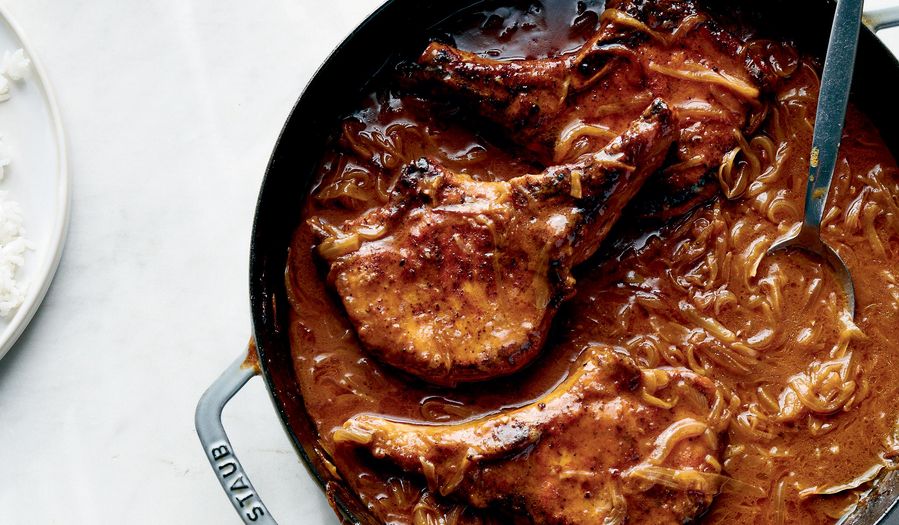
Smothered Pork Chops
Sam Sifton · The New York Times Cooking: No-Recipe Recipes
This flexible, "no-recipe" recipe from The New York Times Cooking is classic, American-style comfort food; melt-in-the-mouth meat cooked in a rich, deeply savoury sauce. Serve it with steamed rice and wilted greens for a rainy day feast.

Soft-Boiled Eggs With Anchovy Toast
Sam Sifton · NYT Cooking
This is a no-recipe recipe, a recipe without an ingredients list or steps. It invites you to improvise in the kitchen. If you’re up for a delicious, slightly sporty breakfast, you might consider making some anchovy butter tonight. Take a stick of unsalted butter, and let it soften on the counter while you assemble the other ingredients: a tin of anchovies, some garlic cloves, a shake or two of smoked or regular paprika, a wee splash of lemon juice and maybe, but probably not, some salt. Rinse and mince the little fish, mince the garlic, and fork everything together into the butter to taste. Then, come morning, you can slather toast with the result and serve it with soft scrambled eggs or, better yet, soft-boiled eggs, a breakfast I once had in London at a hotel and restaurant the chef Fergus Henderson was running in Leicester Square. Make sure you spread the butter “wall to wall.” That is a vernacular phrase of the chef Gabrielle Hamilton. It means to cover the entire surface of the br

Soubise
Sam Sifton · NYT Cooking
Suzanne Goin, the chef and owner of a number of Los Angeles restaurants, published a recipe for this surprisingly light concoction of onions, rice, cream and Gruyere in her invaluable 2005 cookbook, "Sunday Suppers at Lucques." Years later, Mark Bittman and I served it as part of a feast menu we cooked up for the Sunday Times Magazine. It is a marvelous accompaniment to roast chicken. Sam Sifton

Speedy Fish Chowder
Sam Sifton · NYT Cooking
This is a no-recipe recipe, a recipe without an ingredients list or steps. It invites you to improvise in the kitchen. This one calls for something in the neighborhood of a quarter- to half-pound of fish fillets per person and works as well in the heat of South Florida as it does on the frozen Northern Plains. Dice a strip or two of bacon if you’re a meat eater, or grab some butter if you are not (or use both if you are reckless). Add it to a Dutch oven set over medium-high heat and sauté with a few handfuls of diced onions, carrots and potatoes until the onions have gone translucent. Hit the mixture with some salt and pepper and a flash of smoked paprika if you have it. If you can find good corn on the cob, that would be a fine addition. So would a cup of frozen corn. Do you have any fish stock? No? White wine? Surely you have water. Add enough liquid (of any combination of the above) so that the potatoes are almost swimming, then add a bay leaf and reduce the heat to a simmer. Allow

Steak Tacos With Pineapple Salsa
Sam Sifton · NYT Cooking
This is a no-recipe recipe, a recipe without an ingredients list or steps. It invites you to improvise in the kitchen. Get some fresh tortillas and a pound of skirt steak, then make salsa from mostly fresh or canned pineapple, pickled jalapeños and a healthy couple shakes of chile powder, along with plenty of chopped cilantro. Shower the steaks with salt and pepper, and broil them for 2 to 3 minutes a side until they’re perfect and rare. Warm the tortillas. Grate some Cheddar. Rest the steak, slice it, and serve with the tortillas, cheese and that awesome salsa. Anyone want to watch a movie after dinner? We have time. Sam Sifton features a no-recipe recipe every Wednesday in his What to Cook newsletter. Sign up to receive it. You can find more no-recipe recipes here.

Steamed Mussels With Tomatoes and Chorizo
Sam Sifton · NYT Cooking
This is a no-recipe recipe, a recipe without an ingredients list or steps. It invites you to improvise in the kitchen. Simplicity itself, if you can find a bag of mussels at the store. Scrub and debeard them as necessary. Then grab a big pot, and use it to sauté some cubed chorizo in olive oil over medium-high heat. When it starts to crisp, add a few handfuls of halved cherry tomatoes and a clove or two of chopped garlic. Let the tomatoes blister in the fat, then add the mussels and a glass of white wine. Cover the pot and allow the mussels to steam open. (If at the end you have mussels that haven’t opened, ditch them: They’re dead.) Garnish with chopped parsley and serve with plenty of toast for the sopping. Sam Sifton features a no-recipe recipe every Wednesday in his What to Cook newsletter. Sign up to receive it. You can find more no-recipe recipes here.

Takeout-Style Sesame Noodles
Sam Sifton · NYT Cooking
Noodles dressed with sesame are popular in many parts of China, but this particular style, made with peanut butter and served cold, became a Chinese-American staple in the United States in the 1970s. The family of Shorty Tang — an ambitious restaurateur who emigrated from Sichuan to Taipei to New York — firmly believes that he invented the dish and still serve it at Hwa Yuan, the restaurant he opened in 1967 in Manhattan’s Chinatown. They have never divulged the exact recipe; this is our own lush but refreshing version. Sam Sifton

Tater Tot Casserole
Sam Sifton · NYT Cooking
I first ate this hot dish, a Midwestern favorite, on a late fall evening in the humid kitchen of the cook and television star Molly Yeh, at her farmhouse in Minnesota. The casserole accompanied venison, lefse and talk of the sugar beet harvest outside. I thrilled to the cream-beefy, umami-strong flavors that sat beneath its golden, cobbled exterior, and I loved the way the potatoes soaked up the gravy that pooled below the venison. You could substitute other ground meats for the beef, and other frozen vegetables for the peas or corn, but the tots are mandatory, and I do love the addition of cheese at the end. Sam Sifton

The Store’s Green Dip
Sam Sifton · NYT Cooking
Bert Greene was one of the owners of the Store in Amagansett, a gourmet shop and catering outfit on the eastern end of Long Island, N.Y., that was in the early 1970s a kind of lodestar of casual-elegant cooking and entertaining — expensive and, to those with the money to spend it, worth it. (He was like a cross between Ina Garten and Anna Pump, of Loaves & Fishes in Sagaponack.) This is his recipe for a tart, abrasive and wildly delicious dip to serve, garnished with watercress, with an enormous quantity of iced, slivered vegetables. (It’s also great on fish, sandwiches, or even as a dip for slices of delivery pizza.) Sam Sifton

Tofu and Green Beans With Chile Crisp
Sam Sifton · NYT Cooking
I love to cook with chile crisp, a fiery hot-pepper condiment born in the Sichuan Province of China that generally relies on fried shallots and garlic for texture, and on any number of umami-rich special ingredients for distinction and oomph. It’s magical: a boon to noodle soups and kitchen-sink stir-fries, to eggs and cucumbers, to plain steamed fish. Here, I use it as the base of a marinade and topping for baked tofu and green beans, with black vinegar, a little sesame oil, a wisp of honey, minced garlic and ginger, along with scallions and cilantro. But you could use the mixture on a mitten and have a very nice meal.

Turkey Brine
Sam Sifton · NYT Cooking
This classic wet brine is adapted from an old Yankee Magazine recipe for a traditional New England roast turkey. It yields a moist and tender bird.

Veal Chops in Cherry-Pepper Sauce
Sam Sifton · NYT Cooking
You can use this sauce — spicy and fragrant and slightly syrupy, what the Italians call agrodolce — on veal chops as I call for here, or on pork chops, on steaks, on chicken. I bet it’d be good on grilled seitan or drizzled over tofu. The recipe is reminiscent of the cooking at red-sauce emporia like Bamonte’s in Brooklyn, Rao’s in Manhattan, Dominick’s in the Bronx and, I hope, Carbone in Greenwich Village, where I first learned how to put it together at the elbow of the chef Mario Carbone. Serve with spaghetti dressed in butter and Parmesan, with garlic bread, with a spoon so you can slurp what’s left on the plate. “It’s a flavor that’s purely Italian-American,” Carbone told me. “You won’t find it in Italy, no way.”

XO Sauce
Sam Sifton · NYT Cooking
In Hong Kong in the 1980s, when expensive Cognac was all the rage, legend has it that some smart cook at the Spring Moon restaurant in the Peninsula Hotel on Kowloon got it into his head to name the funky new condiment he’d come up with after the status mark on the bottle of Remy Martin at the bar: “XO,” extra old, rare, very expensive. The stuff was a hit: dried scallops and dried shrimp, a ton of chiles, a faint pork-smokiness and a whisper of allium, expensive to make and worth it for the flavor-enhancing pop. By the end of the decade, XO sauce was on menus all over Hong Kong and eventually the world. Recipes for XO vary wildly, save for those scallops and shrimp. Mine derives from the teachings of Diana Kuan, who included a formidable XO in her 2019 cookbook, “Red Hot Kitchen.” Sam Sifton